
It’s time for payments professionals to give autonomous vehicle fleets a hand – with payments. That’s why we launched www.v2xpayments.com as a one-stop shop for AV payments needs.


Fintech Law Adam Atlas Attorneys at Law
Fintech Law for Payments Money Services Business and Crypto
It’s time for payments professionals to give autonomous vehicle fleets a hand – with payments. That’s why we launched www.v2xpayments.com as a one-stop shop for AV payments needs.
Pay to pass, yield and earn
Cars will not negotiate traffic based on first-come-first-serve or haphazard passing and yielding. Instead, occupants of autonomous vehicles and drivers will establish a price for yielding their place in traffic to a passing vehicle. A system engaging with all vehicles will support each commuter in negotiating with the aggregate of other commuters producing an agreed order of preference. Each yield event includes payment by the passing vehicle to the vehicle yielding. For each trip through traffic, a vehicle will be a net payor or a net payee. Using the system, commuters will be able to select a time of arrival based on price with shorter commutes costing more. Crypto or fiat wallets integrated with vehicles or their passengers enable instant or periodic reconciliations. Tunnel through time with money instead of diggers.
Legacy model
96 million cars in the US spend 4.7 billion hours a year in traffic congestion[1], that’s 49 hours per driver (4.7 billion ÷ 96 million). This costs each US driver $894 per year, on average[2], or about $18.24 per hour of delay ($894 ÷ 49 hours), and about $85.8 billion in total (96 million × $894). The average US commute is about 27 minutes and 12 miles each way; a total of 24 miles and 54 minutes per commuting day[3]. Moderately heavy traffic consists of about 45 pc/mi/ln (passenger cars / mile / lane) [4]; in congested traffic moving at 30 mph or less, there are about 200 pc/mi/ln, meaning 2,400 cars ahead of a commuter beginning their 12-mile drive (200 × 12) [5]. At 30 mph, a 12-mile commute takes 24 minutes. Individuals from higher income households, earning more than $50,000 per annum, commute over much greater distances – often twice as far – than those of lower income households. [6]
Novelty
By paying each car to yield in heavy traffic, a commuter could cut their commute time by more than half. In a simple example, if each of the 2,400 cars ahead of a commuter agreed to yield for $0.005 (half a cent), then a commuter could pass all of them for $12 (2,400 × $0.005). The commuter potentially accelerates to a 65 mph speed limit, passing 2,400 cars and arriving in about 11 minutes instead of 24, a saving of about 13 minutes or 54% of the one-way trip. At $12 per pass, the trip pays for itself for any commuter who values their time at more than about $56 per hour ($12 ÷ 12.9 minutes × 60), well above the $18.24 average hourly cost of delay, which is why we expect higher income commuters to adopt first. Naturally, the mechanics of all yield events in isolation together with effects in other lanes of traffic coupled with commuters willing to pay varying amounts results in a much more complicated cascade of vehicles. The Bitotime system is U.S. patent-pending.
Maps wind-down
Today, drivers spend their entire drive glancing at map apps such as Waze, Google Maps and Apple Maps because they need to know which turn to take next. Autonomous vehicles will release commuters from having to constantly glance at maps. Indeed, the guidance business will wind down. In its place will emerge offers from businesses along the route to potentially pay for the time of your stop as an incentive to add a stop. Businesses might also offer free ride acceleration in exchange for making a stop. Commuters will be able to engage in greater interactive reward mechanics (i.e. gamification) of displacement with competitive pricing and boasting over speed and price combinations.
TAM
165,000,000 people commute to work by car or truck each day in the US[7]. Of those, 96 million are exposed to the congestion described above, at an average cost of $894 per driver per year, or about $85.8 billion in total. With higher income individuals often commuting further, they are more likely to engage with the Bitotime system because they have (i) the greatest ability to pay; (ii) the greatest need to save time; and (iii) the greatest economic incentive to spend less time commuting.
Tunnels will not solve the challenges of traffic congestion. Self-driving cars following legacy driving rules will also not solve the problem. Instead, a marketplace for time will emerge, with vehicles yielding cascading orders of committed value. Commuters who are not in a rush stand to benefit from revenue during a given commute.
Assuming 1% of the 165 million commuters, being 1,650,000 motivated commuters (about 1.7% of the 96 million drivers stuck in traffic), each buy one $12 pass per commuting day on 250 commuting days a year, we foresee about $19.8 million in daily car-to-car payments (1,650,000 × $12), or $3,000 per commuter and an annual volume of payments of $4.95 billion (1,650,000 × $3,000). That is about 3.96 billion yield events per day (1,650,000 × 2,400). Each commuter would save about 54 hours a year (12.9 minutes × 250), worth about $5,400 at $100 per hour, against $3,000 paid. Assuming transportation authorities tax these payments at a rate of 7%, this presents about $346.5 million of potential annual revenue for transportation authorities. With payment transaction cost across stablecoin, crypto currency, Automated Clearing House (ACH), real time payments (RTP) and card varying between 3% and 0.001%, the system’s supporting processing network may offer revenue of between about $50,000 and $148.5 million per year at 1% adoption. The table below shows how these figures scale with adoption.
| Adoption (of 165M commuters) | Commuters | Annual payment volume | Tax at 7% | Processing revenue at 3% | Processing revenue at 0.001% |
| 1% | 1,650,000 | $4.95 billion | $346.5 million | $148.5 million | $49,500 |
| 5% | 8,250,000 | $24.75 billion | $1.73 billion | $742.5 million | $247,500 |
| 10% | 16,500,000 | $49.5 billion | $3.47 billion | $1.49 billion | $495,000 |
The opportunities for system participants are much greater than simple payment processing or taxation. Participants have an opportunity to literally steer traffic to their destination using incentives delivered through the system, including time or arrival. We imagine daily lotteries for the ‘rocket commute’ to pass everyone, skill-based games played in vehicles generating passes, in-vehicle exercise generating passes and many more implementations of living in a new paradigm of time on the road.
Pitch
Payment Network (Visa, MasterCard, Amex): Stake your claim as a leading network for Bitotime system payments. Consider Bitotime as an early use-case for stablecoin settlements.
Maps (Waze, Google Maps, Apple Maps): As use of maps evolve stake your claim as the integrator of retail with commuters offering goods, services and time as incentives.
Vehicle Manufacturers / Fleets (GM, Toyota, Tesla, Waymo): Install the Bitotime system in vehicles to ensure vehicles can participate in the marketplace.
Team
Adam Atlas, Esq., a New York-licensed attorney has provided legal advice and expert testimony to US fintech, crypto and payments companies for 23 years. Atlas is the inventor of the Bitotime US patent that is pending. He brings the whole wheelhouse of payments implementation scenarios, legal framing, state and federal compliance. Atlas also leads a team of five payments professionals ready to execute Bitotime.
Richard Moses, is a patent specialist with two decades of experience supporting global innovators across IBM, Intel, Philips, Fujitsu, and Panasonic. He advises SMEs, Fortune 500 companies, and government agencies on patent prosecution, portfolio assessment, and monetization, with deep subject matter expertise in semiconductors and electronic systems. He is the founder of Pelent, an AI driven platform he launched in 2016 to analyse and optimize patent portfolios. His earlier career includes technical and marketing roles at IBM, Hitachi, and Philips Information Systems. Richard holds both a Bachelor of Science and a Master of Science in Electrical Engineering from Concordia University, graduating with honours. He is an IEEE Fellow and an active member of the Licensing Executives Society (LES) and Professional Engineers Ontario. His academic distinctions include the F. A. Gerard Prize, the Concordia University Electrical Engineering Medal, and a National Research Council of Canada scholarship.
Please contact us through: atlas@adamatlas.com, 514-842-0886.
FAQ
1. People will never agree to this.
With a logjam of autonomous vehicles dutifully obeying traffic laws occupied by passengers wanting to move faster, natural demand will emerge for alternatives to first-come-first-serve traffic. Early adopters may pay exorbitant fees to tunnel through traffic, creating a bid in the market that is irresistible yielding cars. We foresee yield pricing as a material source of tax revenues by cities and transportation authorities. The extreme luxury of sailing through heavy traffic is easily taxed.
2. Cost to pass?
The system foresees a variety of implementations. Each implementation operates pursuant to a set of rules that will combine market forces and legal parameters. For example, in one version, each commuter sets their own price. Car A yields for $0.05, and Car B yields for $0.07. In that system, the rule could be that each car must pay at least their own price to pass another car thereby dampening would-be greedy drivers looking to charge heavy fees for a yield. In another implementation, government sets the applicable price considering congestion levels.
3. What about ambulances?
The system rules accommodate free passing for emergency vehicles. Indeed, any autonomous vehicle network must accommodate yielding for emergency vehicles. The concept of yield and car-to-car communication over yield is inevitable.
4. How do thousands of cars settle with each other millions of micro transactions?
Blockchain, stablecoin, cryptocurrencies and other contemporary payment technologies can quickly accommodate millions of microtransactions.
5. Will some people get on the freeway just to earn money by being passed?
Yes. The Bitotime system will serve as a means of subsidising lower-income drivers. Government will place limits on exploiting the system simply for profit creating unnecessary congestion. For commuters with known patterns of displacement, government may introduce the ‘ultimate yield’, where the commuter doesn’t leave home in exchange for a lump sum varying based on the congestion level and arising market. Consider existing examples of management of congestion to reduce pollution by requiring cars with even or odd license plates to stay home on alternating days. The adoption of AI will strengthen oversight of gamification practices, misuse, and fraudulent activity.
6. Does the system only work with autonomous vehicles?
No. The system could be activated today with a simple add-on to map apps. Before the drive, the driver sets their yield price. A passing vehicle’s app gives the driver a popup of an opportunity to pass for the price of the car ahead; the passing driver accepts the offer; the drivers execute the yield event and payment is automatically processed.
Contact
Adam Atlas
CEO, Founder
2301 Melrose Ave.
Montreal, QC, Canada H4A2R7
514-512-4588
[1] Pishue, Bob, 2025 INRIX Global Traffic Scorecard, 2025, p 16, https://inrix.com.
[2] Ibid.
[3] Federal Highway Administration, National Household Travel Survey, 2025, https://nhts.ornl.gov.
[4] Highway Capacity Manual 2000 Ch. 23, p. 3, https://uomustansiriyah.edu.iq/media/lectures/5/5_2018_02_13!08_57_37_AM.pdf
[5] TRB, Highway Capacity Manual, 6th Edition (2016), Chapter 12, Exhibit 12-7, p. 12-11.
[6] Federal Highway Administration, National Household Travel Survey, 2025, https://nhts.ornl.gov.
[7] US Census Bureau, https://data.census.gov/table/ACSST1Y2024.S0802?t=Employment.
At adamatlas.ai we provide legal advice to your ai agents.

Our fintech and crypto clients at adamatlas.com are often asking their ai agents what they should ask us lawyers to do.
Old Way of Hiring Fintech or Crypto Legal Counsel
The work flow often looks like this:
New Way of Hiring Fintech or Crypto Legal Counsel
We propose a new model for engaging us as follows:
Our work product can be delivered by email to the client or their agent to preserve privilege. Our work is not ai generated, it is delivered directly for use by the client through their agents.
Drop us a not and tell us what you think of this effort to liberate founders from having to deal directly with us lawyers.
Adam Atlas
Admitted in New York.
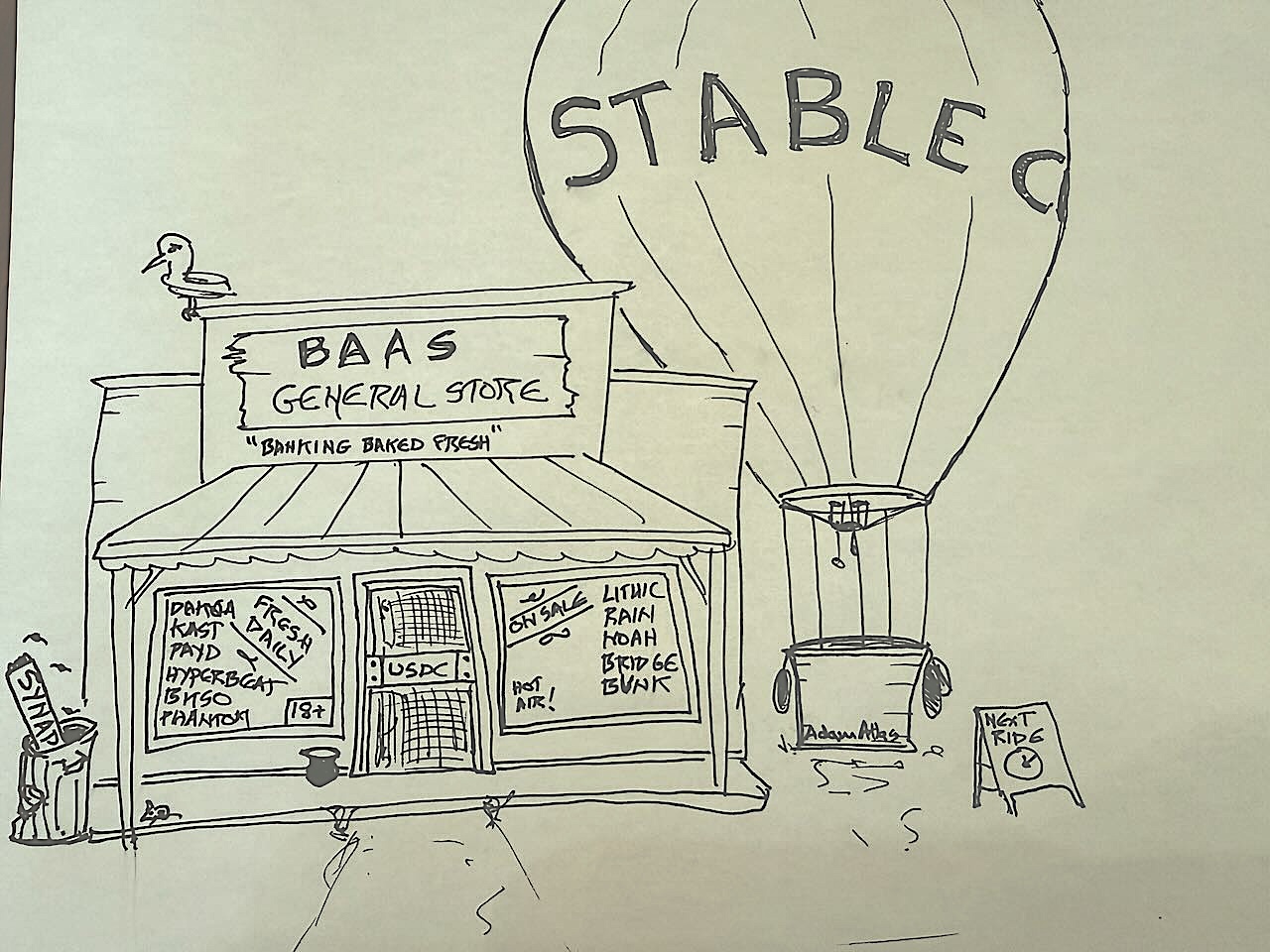
Integrated payments fka BAAS
Integrated payments are the new BAAS. This isn’t your dad’s ‘pocket-protector API to a bank’. Integrated payments is code that plugs seamlessly into any platform to add fiat, crypto and stablecoin settlement in seconds. Gone are the days when users are driven through docusign dda account docs with the sponsor banks. Now the bank terms (if any) are sometimes hard to find.
We were supposed to learn from actions concerning Synapse by The Fed, FDIC, OCC, Bankruptcy Court. There was even an article Yale Journal of International Affairs, not to mention countless breathless posts by Jason Mikula in his excellent Fintech Business Weekly substack. The tragic comedy of Synapse probably peaked in October of 2025 when Evolve’s new CEO hired to cleanup ironically faced unrelated but serious charges. To their credit, the new generation of integrated payments players move fast, but there seems to be a greater-than-ever legal gap between the end user and the financial institution holding assets. Even with all parties acting in good faith, that gap will present challenges to parties that are trying to asset their rights in funds or digital assets in play.
Thankfully and true to its name, Lead Bank is picking up the slack after the legacy crew of SVB, Silvergate, MCB etc… went under or ran for the hills. Cross River Bank is also powering a lot of integrated payments.
We recommend that end users be informed about exactly which institution is holding their funds. Not just because Texas crystalised the rule on this ten years ago in DOB Supervisory Opinion 1038, but because the ‘data platform only’ services need to be able to prove that someone else took liability for user fiat or digital assets in play.
Stablecoin to the moon
What else we can do to get stablecoin pumping? Genius Act, STABLE Act, OCC, The Fed the SEC. But wait, stablecoin is never supposed to pump, it’s just supposed to be backed by treasuries and serve as a faster cheaper bank ledger. Indeed, Circle is angling to be the world’s bank. Not to be left out, Visa and MasterCard each have their own stablecoin rails. MasterCard even bought BVNK which looks like it solved stablecoin remittance. BVNK is a leader in newen integrated payments using its own licenses but also Paxos for digital asset custody, Rain / Third National for fiat custody and Lead for remittance. There are so many ‘I also have a stablecoin’ to keep track of, like MoneyGram’s MGUSD, it feels like 1820.
Meanwhile, central banks around the world use foreign exchange as a source of income for the bank and the country. This presents a challenge for international adoption of stablecoin. Brazil has banned remittance by stablecoin. Optimistically, this kind of ban is temporary to leave room for local stablecoins to come into existence allowing central banks to retain their traditional hold on exchange rates while plugging into USDC and the like.Agentic payments
What’s in your agent’s wallet? The leading case on agentic shopping right now is Amazon v. Perplexity. Amazon doesn’t like users shopping with the Perplexity bot because the bit doesn’t pay attention to ads and stays ‘on task’ buying what they are instructed to buy. This case is a ‘finger in the dyke’ to an incoming avalanche of bots shopping and doing everything else (including legal lol). Perhaps the next most interesting legal finger pointing might be between publishers of agents and those who use them and drop in payment credentials. My flight was supposed to be to Paris, France not Paris, Texas and the like. Fortunately, payment networks bring to the table a wealth of experience with error resolution and chargeback dispute management that can be adapted to the air gap between a rogue agent and their user. Within that gap there might also be opportunities for arbitrage of the error – e.g. reselling the ticket to Paris, Texas on a secondary market. When implementing agentic payments, it might make sense to include: (i) specific risk disclosure around agent-initiated payments; (ii) audit trails for decisions made; and (iii) a dashboard feature that discloses the allocation of liability as between user, fintech, ai, issuer, acquirer, merchant etc… Issuers have an opportunity to claim open territory in the ‘agent with a card’ space. Integrated ai payments providers can help cut early trails into this new territory.
My favorite vibe coding platform is Replit where we host a few custom agents that accelerate our legal work. If I can spin up apps there, so can you.
Conversation concerning Subpart B of Regulation E, the Remittance Transfer Rule.

| Unique and actionable content only. Adam Atlas Attorneys at Law laying out all the fintech and crypto that’s fit to wear this fall. 1. BAAS APIs. A Banking-As-A-Service (BAAS) API is an API that allows a fintech or other platform to seamlessly roll banking into their services. Long ago, fintechs spent millions on money transmitter licenses, then, a new generation spent hundreds of thousands of dollars to find a bank and build an integration. Now, they spend a few thousand a month to tag along one someone else’s integration. From grand-daddy Synapse to second acts like Column, Mercury and Solid, there seems to be a new API bank launched every week. While the OCC (that regulates banks) favors digitization, it and the Fed are paying close attention to these integrations and the risks they pose for consumers and banks. 2. Fintech-As-A-Service (FAAS) is the broader suite of platforms that offer more than just bank accounts, they also offer card issuing, ACH processing, money transmission, crypto custody or exchange, lending and even custody of securities. Leading institutions behind the smorgasbord of offerings are Silicon Valley Bank (for well funded startups that like the FBO model), Evolve Bank & Trust, Prime Trust, Metropolitan Commercial Bank, Cross River Bank, Signature Bank (backing Circle‘s stablecoin USDC), Emigrant Bank and increasingly Zero Hash and Wyre along with Prime Trust for crypto-focused projects. (ps a Stablecoin laugh over here). Caselaw from these new models includes a claim concerning funds in an FBO account, a dispute over frozen funds, issues over state licensing of a trust. 3. Acquiring Consolidation. The boomer acquiring universe continues its cannibalistic consolidation which is putting more fear into market participants than excitement. Lawyers (like us) and investment bankers are, however, earning great fees. The payfac was supposed to spur creativity in acquiring. Payfacs have sometimes had a hard time competing against dominant players like Paypal, Stripe and Adyen. It seems payfac has settled into a new onramp for ISOs. The payfac model did spawn a clutch of platform integrations that help new payfacs avoid the high cost of tech including Payrix, Finix and Infinicept and it gave new life to established gateway platforms like NMI. Btw, congrats to our alumni USAePay and IRISCRM who were both recently acquired by NMI. Everyone and their uncle has an issuing program now, so we won’t reheat that story in this update. 4. Privacy-As-a-Service. PAAS is tomorrow today; it is the first tangible step towards the inevitable automation of law. Why pay us piles of money to read the CCPA and GDPR rules when you can have it done for you on subscription. (Btw, US entities that hold data on EU persons need to comply with GDPR.) We are only too pleased to allow this part of our practice to be automated. As with sanction screening automation privacy policy and practice automation is a step in the right direction. We expect this to eventually become mandatory. Don’t worry, we’ll find another way to add value. 5. Crypto Winter II: Featuring the Coldest Rug-pulls Ever! When our tally of frozen or lost crypto in the current winter reached $83 billion, we stopped counting. Implosions of Celsius, Voyager, Luna and others are comforting to the platforms that are taking the long route by spending millions to pick up and maintain state money transmitter and virtual currency licenses. As hodlers burn their furniture to keep warm and run their mines this winter, our Altas (haha) of fintech.law now has a bit on Crypto Skeptics for a few laughs under the blankets: Tolly McTrollface was the pioneer in that space and is now being succeeded by Amy Castor her partner David Gerard, the Crypto Critics’ Corner podcast by Cas Piancey and Bennett Tomlin and a handful of others. No fintech movement is complete without an association, so the crypto skeptics have one also – the Center for Emerging Technology Policy. They also had what Cointelegraph called a ‘haters’ conference which was as funny as it was serious and really a perfect way to begin a plummet to the next bottom. 6. Oh Canada! Thanks to the freedom convoy of truckers, there has been a lot of clucking about increased regulation of payments in Canada. Four highlights emerge: (1) Oddly, Crowfunding platforms need an MSB registration – even if they do not touch funds. (2) Payment processors are supposed to call Fintrac (which now has a youtube channel) and ask if they are MSBs or not; Canadian MSB law and regs are not clear enough, hence the need for a regulator judgment call on each model. (3) Sometime in the next year or so, payment processors (MSB or not) and MSBs will have to register with the Bank of Canada under the new Retail Payments Activities Act. (4) We’ve summarized Canadian crypto law here.Please say hi to us at Money2020 Oct 24-24, we spent all our tooth fairy money on admission.Adam Atlas Attorneys at Law is licensed in New York and Quebec. This email is ATTORNEY ADVERTISING. Nothing in this e-mail should be construed as a legal opinion or commentary on laws other than in the two jurisdictions where the author is admitted. Adam Atlas Attorneys at Law Fintech Toolbox Neobank.law Fintech.law Payments Business Ideas  Adam Atlas Attorneys at Law |

At Adam Atlas Attorneys at Law we are thankful to our clients for engaging us for legal advice in support of their visionary ideas.
1. Digital Payments Explosion. With Covid rendering cash dirtier than usual (‘lol’) nearly everyone in electronic payments is breaking records, including Amazon, Shopify, Paypal, Adyen and Square. Rapid migration from f2f to online sales has created a lot of activity for new and existing payfacs, ISOs and other payment processors.
2. Wirecard. Other than producing one of the top three payments videos of all time (the other two being about lawyers who help launder money and the unforgettable and classic bitconnect video), the Wirecard fiasco has given all investors and payments companies alike a stiff reminder that they too must answer to reality. It has also created opportunities for investors to pick up some of the good parts of Wirecard.
3. Cryptocurrency Enforcement Framework from the U.S. Department of Justice. Author of the framework, Attorney General William Barr said, “Cryptocurrency is a technology that could fundamentally transform how human beings interact, and how we organize society. Ensuring that use of this technology is safe, and does not imperil our public safety or our national security, is vitally important to America and its allies.” To that end, the framework sets out the threats, illicit uses and enforcement strategies under the law. Here is a short summary of the framework. At a minimum, crypto businesses should adhere to BSA best practices in AML and risk mitigation and take advantage of the many third party services that help scrub addresses and users for sanctions, dark web and illegal activity.
4. DeFi. For those who missed Bitcoin’s early leaps in value, or the ICO moment, there is now DeFi. Decentralized finance platforms, such as Uniswap and Curve offer the theoretically irresistible opportunity to eliminate centralized exchanges and their fees by allowing users to trade peer-to-peer at a discount through secure and trustless contracts mostly on the Ethereum blockchain. Meanwhile, liquidity providers for the platform earn fees (governance tokens) in consideration for allowing their assets to serve as liquidity in the decentralized exchange. Here is a list of the sixteen largest DeFi platforms together with some notes on them. Like all new crypto services, DeFi has had a handful of blunders, such as the hack at Harvest and the other hack at bzx. A lot of legal work remains to be done (by us 😉 on these platforms.
5. Banks Taking Crypto. The OCC has published guidance expressly permitting banks to accept fiat as reserves for stablecoins. This is a tip-of-the-hat to stablecoins that have already been licensed in states like New York are building impressive balances and backing eye-watering transactions on a daily basis. The OCC guidance does not, however address the many stablecoins that do not track who actually holds them, in the way that a bank account tracks who holds an account. Wyoming has become the darling of crypto by granting charters to Special Purpose Depository Institutions that can take Bitcoin and other crypto on deposit. There is no news on whether those institutions will end up also needing other state MSB licenses as some other trusts have learned. Here is our running tally of www.banksthattakebitcoin.com – there are 5.
Wishing you a very Happy Thanksgiving and Holiday Season!

First, we wish you and your team the best of health and safety at this difficult time.
While keeping a distance from people, getting up close and cozy with digital payments is the order of the day.
1. Financial Services are an Essential Service. If you wish to confirm the local legal status of your payments or crypto business, please refer to our list of all state-level banking department orders to the effect that payments are an essential service. These state-level updates mirror action taken at the federal level, including the Federal Reserve, CFPB, CSBS and CISA.
3. Stimulus for Payments Businesses. The Coronavirus Aid, Relief and Economic Security (CARES) Act, of March 27, 2020 provides $2 trillion in funds for the economy, some of which are accessible to payments businesses. There is $349 billion in low-interest, forgivable loans for small business and 1099s may be eligible for up to 39 weeks of benefits.The Green Sheet has published an article discussing this topic as it relates to ISOs.
2. New York – Financial Services in the Empire State. Our thoughts are with New Yorkers who are right now weathering the eye of this storm. New York Governor Cuomo instituted Executive Order 202.6 on March 18, 2020. The Executive Order extends the provisions of Executive Order 202 which declared a state of emergency in New York state. Under E.O. 202.6, any essential businesses in the state will not be subject to the mandated restrictions including work from home mandates and reduced work forces in order to limit the spread of Covid-19. “Banks and related financial institutions” have been included in the enumerated essential business and services in E.O. 202.6. The guidance includes banks, insurance, payroll, accounting and services related to financial markets. Businesses may also apply to be deemed essential by the Empire State Development Corporation.Since it is not explicit that money services businesses qualify as essential services, it is recommended that any money service business operating in New York state apply to be deemed an essential service.
The application is a one page form, where the applicant must include:
Name
Contact information
Number of employees
Description of business
Description of why business fits within the parameters of E.O. 202.6
E.O. 202.6 can be found here.
The application form can be found here.
Executive Order 202.9, dated March 21, 2020 gives powers to the Superintendent to promulgate emergency regulations for the period of the emergency that the fees for using ATMs, overdraft and credit card late fees may be restricted or modified to take into account the financial impacts on New York consumers and the safety and soundness of the licensed or regulated entities.
3. Force Majeure Clauses in Payments and Crypto ContractsSadly, because of the Covid-19 pandemic, some participants in the payments industry will be unable to meet their contractual obligations. The purpose of this newsletter is to give some guidance to people on either side of that terrible turn of events. Specifically, I want to discuss force majeure clauses that are the clauses that are most likely to apply to a pandemic-caused contractual default.
Force Majeure Clause
The force majeure clause in contracts is usually buried in the general provisions at the end of the agreement and is rarely negotiated or even read. The pandemic has suddenly given great importance of force majeure clauses. Case law borne out of this pandemic will be cited for decades to come.
A typical force majeure clause in a payment processing agreement reads as follows:
“Force Majeure. No Party shall be liable for any default or delay in the performance of its obligations under this Agreement if such default or delay is caused, directly or indirectly, by an Act of God, fire, flood, earthquake, conditions or events of nature, war, terrorism, riots, pestilence, civil disturbances, work stoppages, equipment failures, power failures, governmental orders, or any other similar cause or event beyond the reasonable control of the affected party (provided the non-performing Party is without material fault in causing such default or delay).”
The key legal question when facing a force majeure clause is to determine whether it relieves the party of default for non-performance. In other words, but for the force majeure event, would the failure of the party place them in default. For example, without a tornado, I would have delivered the garden shed you ordered. Because of the tornado, I can’t.
Force majeure clauses in contracts are included to allow one or more parties to an agreement to not fulfill their obligations should certain circumstances arise. The event contributing to the application of the force majeure clause should not only be unforeseeable, but also beyond the control of the parties. Unforeseeable here, means unforeseeable at the time the contract was entered into. As in the typical clause example above, force majeure clauses outline the types of situations where the clause may excuse non performance. Since such clauses are a construct of the parties, the meaning and scope shall be those given by the parties in creating the agreement. Where clauses are lacking or where there is room for interpretation, courts will apply common law principles.
What if the force majeure clause does not list ‘pandemic’?
Many drafters of force majeure clauses include “catch-all” phrases to extend the provision to non-enumerated situations by including words such as “other” etc. Courts tend to apply the ejusdem generis (Latin for ‘of the same kind’) theory when determining if a given situation fits within the catch all phrasing. Ejusdem generis dictates that when general terms follow an enumerated list of two or more items, then the general terms must apply only to items of the same class as those enumerated. The potential application of ejusdem generis to a force majeure clause must be kept in mind not only when drafting such clauses, but also when formulating argumentation to either defend or argue the non-applicability of a force majeure clause.
When analyzing force majeure clauses, courts will often ask three questions:
Case Study 1: ISO can’t make minimums because of Codiv 19
Taking an extreme but illustrative example, if an ISO has focused on selling merchant services to amusement parks, and all amusement parks are closed by order of the state, even if the force majeure clause in the ISO agreement does not expressly mention pandemics, generic wording on factors beyond the control of the ISO would likely support the ISO in being relieved from its liability for minimums. Most ISOs, however, do not sell to only amusement parks, and will face a challenge of proving that the circumstances are a force majeure, in particular given that online sales are surging right now.
Case Study 2: Crypto platform inoperable because of Covid-19.
Suppose key officers (e.g. CIO, CCO) at a crypto wallet or exchange were all out of action because of Covid-19 for an extended period of time. Suppose as well that, despite having (often legally required) disaster recovery and business continuity plans, those plans were ineffective because other key personnel were out of commission. The crypto business grinds to a halt. Customers will be frustrated because they are not able to get support or possibly access their assets. Here, a court might look to the crypto operator to have had a more robust disaster recovery plan. Assuming the problems are not caused by infrastructure (e.g. Amazon down) or orders to close by the state, the crypto business will have a harder time arguing that they were legally relieved of their obligations on account of force majeure. The reason for this is that, in this case, the causes are not external to the business.
Cases decided on the basis of the Covid-19 pandemic will be studied in law schools for the next 100 years. I hope none of our readers are the basis of that new law.
Community Service: Pro Bono Advice on Force Majeure Clauses
As our way of giving back to the payments and crypto community that sustains us, we will provide free review of any force majeure clause in payments or crypto.
4. Stay Healthy and Safe, Electronic Payments and Crypto Surge (?), Atlas Team Publishing Tools to Help
Our whole team is actively researching solutions for the financial services sector for these difficult time and we will share all useful information as and when we collate it. (Regular readers know how much we love lists, charts and more lists). In the meantime, stay healthy and safe in anticipation of (hopefully) a surge in electronic payments and crypto after Covid-19 like none of us could have ever imagined – when the crisis is over.
Adam Atlas Attorneys at Law is licensed in New York and Quebec.

Fintechs spend a lot of time trying to understand their US MSB risk. Our firm believes in open source legal information. So, we created the first and only regtech AI MSB risk assessment bot tool. Give it a try and tell us what you think:
The tool is not legal advice, but it might help guide early stage fintechs and help them avoid potholes.

While the financial press is busy obsessing over WeWork and ignoring the anti-trust oligopoly forming in payments, let’s look at another topic with too little discussion in U.S. financial press: the Bank as API. Neobanking or open banking is all the rage in Europe. It’s not clear why U.S. banks have been slow to open their API’s, but one does sense the whiff of a lack of competition in U.S. banking, (a subject that is the central thesis of Thomas Philippon‘s excellent book, The Great Reversal, How America Gave up on Free Markets).
Now, in Europe, open banking starts from the premise that users of financial services have a right to compare like providers, access data and easily switch from one to another, a bit like phone service providers. In the US, the difficulty in accessing and comparing financial service data has created a market for non-bank solutions for accessing bank services such as Yodlee, providing consumers with account information, Geezeo connecting APIs of a limited set of participating banks, through to Synapse sitting between a bank and fintechs to enable fintechs to offer everything from DDAs to virtual cards with ease. There is now a run on picking up the technical slack of US banks coupled with the lack of competition in US banking that is driving a good number of new entrants. (Even we, quite shamelessly, picked-up neobank.law a year ago).
(Ok boomer,) US neobanking players fall into three categories.
1. Financial Institutions where APIs Come First. These are licensed US banks, trust companies or MSBs that position API access as a key distinguishing feature. SVB, BBVA, Evolve Bank and Trust, Prime Trust, Dwolla and Bitgo. The opportunity for these suppliers is that they can serve large numbers of new clients via API with assistance from fintechs as agents. The risk for these suppliers is that they may each be operating dozens of different business models that present a challenge for
2. Technology Platforms Between FIs and Fintechs. These entities avoid taking control or possession of transaction funds and remain primarily data-only gateways Examples include Plaid and Synapse. (Some financial institutions have preferred to own the IP to the APIs that connect to their accounts, a leading example of that would be Stripe). The opportunity for these entities is to earn a piece of transaction volume without having to pay the price of being regulated entities. The risk for these suppliers is that regulators will find them to be MSBs despite their carefully avoiding possession of transaction funds. Because of their tight integration with financial institutions, these platforms make ‘classic’ boomer gateways, like Authorize.net and NMI, look quaint.
3. Fintechs. These entities navigate gingerly between avoiding regulation by relying on their financial partners (see Item 1 above) and being regulated as MSBs. These 50 or so fintechs use APIs of the FI’s identified above to operate their businesses. We have indicated which are the most likely financial services that each has outsourced to the FI indicated and they include DDA, Card issuing, ACH, crypto custody and money transmission. The opportunity for these entities is to decrease the cost of compliance (using FI’s identified in Item 1), decrease the cost of development (using technology identified in Item 2 above) and focus on the business of selling their service. The risk for these entities is excessive reliance on third parties for compliance and technology and the risk that regulators will perceive them as MSBs, even though licensed financial institutions take legal liability for the movement of client funds.
Whether the OCC clamps down on FI’s in the space or state banking regulators deem tech platforms to be MSBs, there is an overwhelming momentum in the US neobanking space that is driven by real demand for competition and variety in consumer and business financial services that we think will be met ever more in 2020. At Adam Atlas Attorneys at Law, we provide commercial and compliance advice for US neobanks, such as they may be.
Money services businesses (such as money transmitters, prepaid card program managers, currency exchangers and providers of virtual currency) (“MSBs”) that operate outsider of the United States are likely familiar with the laws applicable to them in their home jurisdictions. Given the electronic nature of many MSB businesses, it is altogether likely that a non-U.S. MSB will wish to provide services to residents of the U.S. without having accounts, offices or any other presence in the U.S. Doing so requires compliance with U.S. law. Whether a given MSB is an MSB for the purposes of U.S. federal or state law is a matter of U.S. law. At the federal level, MSB status in the U.S. is determined pursuant to the Bank Secrecy Act (“BSA”), its regulations (“Regulations”) and the Financial Crimes Enforcement Network, of the United States Department of the Treasury (“FinCEN”). FinCEN is the U.S. equivalent of, for example, the FCA in the U.K. or FINTRAC in Canada.
An entity that is deemed an MSB under the BSA has to register with FinCEN, for AML and transaction reporting purposes and may also be required to obtain money transmitter licenses from each individual state in which the MSB has customers.
Being entirely foreign to the U.S. and having no accounts, office or employees in the U.S. does not diminish the application of the BSA to an MSB that services U.S. residents. This information often comes as a surprise to the many thousands of non-U.S. MSBs that, de facto, service U.S. residents.
By way of example, the UK money transmitter in the flow of funds described below that takes funds from a U.S. resident and forwards those funds, as a money transmitter, to a payee or recipient in Germany, is required to be registered with FinCEN and licensed as a money transmitter in the state where the US payer is located:

We provide more discussion of US MSB compliance at www.fintech.law.
This bulletin does not constitute a legal opinion and may not apply to your specific circumstances.
Adam Atlas Attorney at Law is licensed in the State of New York and advises on U.S. crypto and payments businesses from his offices in Montreal.

Competition in Payments
Our recent post to LinkedIn of the US Payments Family Tree generated record feedback. There is thirst for a above-the-tree-line view on who is who the payments landscape. Once upon a time, everyone read the Nilson Report that amazingly published regular figures on the volume of processing at each US acquirer. Divining competitors is not that easy anymore. Here are a few reasons why the competitive landscape is more complex and interesting:
1. ‘Big hat, no cattle’ processors. With bountiful capital (2017 fintech investments $31 billion, 2018 $39.6 billion and the first half of 2019, $27.9 billion), fintech startups have had the luxury of being unprofitable. Square and Stripe exemplify fintechs for which profit is a difficult question. Possibly profitless market-leaders like Uber, Airbnb and WeWork had investors mesmerized by the idea of losing a lot of money for a chance to capture a whole market. It’s hard to assess competition in payments when some of the ostensibly largest players do not answer to the real world of profit. All that glitters is not gold; some of the putative payment market leaders might not be real-world leaders.
2. Eventually, price matters. A lot of merchants operate on very thin margins, with pre-tax profits close to 3%. Processor fees such as Square 3.5%, Stripe 2.9% and Shopify 2.9% are perhaps not sustainable even if they do excel at UI and service. Operating on ever-tigher margins and in a potentially recessionary economy, merchants might tire of easy-to-use, but expensive processing in favor of the old standards, like First Data, WorldPay, TSYS, Global Payments and Elavon. Expensive competitors might not last.
3. Processor Consolidation. Speaking of old standards, where there was once about 13 large US processors, now there are about half that number. The chart above keeps alive some of the old, now consolidated brands, to give you a sense of the dramatic reduction in US processing competition. The FTC has a large mandate, including its Bureau of Competition. If you are an ISO shopping for a processor, or a bank shopping for a processor for your card issuing business, or a merchant shopping for payment processing, the last year has seen a material reduction in the number of competitors for your business. The FTC has brought recent cases against fraudulent or dishonest processors, but it has yet to bring a case concerning the reduction in US payment processing. Perhaps the titans of US processing are circling the wagons in the face of competition from novel payment methods, such as crypto. Too much consolidation, however, is illegal.
4. Crypto Displacing Money Transmitters? Crypto, most prominently, Bitcoin and Ripple / XRP, have been promising to displace money transmitters and other payments businesses including. Greyscale, for example, promises to replace gold as a store of value with bitcoin, a service promoted through their now classic ‘drop gold’ video. More recently one FANG and a bunch of other gig-economy players created Libra, a kind of company-town scrip that promises more of the same. Meanwhile, the traditional remittance market and others under theoretical threat from crypto are posting losses and layoffs. Is Ripple’s investment in remittance player moneygram the reason? Probably not, but note that that investment might be fueled by excessively cheap capital in the form of Ripple’s own XRP issuance, and not necessarily by efficiency or long-term promise of profit.
5. Neobanking, Open banking, Payments as API. There was a time when a payor knew their financial institution and chose them for their brand, relationship and location. That time is over. Now, the financial service provider has been moved into the background in support of neobanking fintechs that provide the consumer-facing service related to bank accounts, card issuing, bill payment and other traditional bank services. Five examples from a growing list come to mind: Evolve Bank & Trust, a bank that is integrated with Synapse, an API platform, Prime Trust, a Nevada trust that provides both crypto and fiat custodial services, Silvergate Bank, a cornerstone of crypto banking now branded as being API driven, Cross River Bank, focusing on fintech with a history of supporting new lending models and arivalbank, that boasts reinventing the bank and an upcoming US launch. By outsourcing technology to startups and keeping the core banking function in-house, these financial institutions are perhaps in a strong position to challenge the older brick-and-mortar / brand-based banking incumbents. The key question for neobanking is, how far into the background will the OCC let financial institutions go.
At Adam Atlas Attorneys at Law, we advise on the commercial and compliance aspects of all of the above and more.

For better or for worse, centralized control of value (and values 😉 is eroding. It takes less than an hour to launch a crypto currency. For example, there are a million Adam Atlas Coin in existence. (They have no value and are not for sale.) As a defensive measure, the established players are circling the wagons (or should I say, building centralized ledgers) into various controlling portions of the market. Taken together, the market looks like it’s admitting defeat to decentralized exchanges of value (i.e. virtual currency) and attempting to extract one last round of return before a more complete paradigm shift.
Single Suppler for Credit Card Processing?
There now exists a single predominant payment processor in the US and, perhaps, the world following the recent mergers of WorldPay, Vantiv,First Data, BluePay, CardConnect into FIS. A small band of outliers are still going it alone, including TSYS, Elavon, Paysafe and Sage. The anti-trust implications of these mergers are substantial and we are already witnessing decreased competition for ISO relationship opportunities. None of the merged entities have an interest in competing with the others as they are all part of a predominant supplier of payment processing in the US. The competitive impacts should be monitored by merchants, ISOs, but also issuing banks that would probably prefer greater competition in transaction processing.
Libra payment processing: Facebook and sharing economy eating from bank deposit balances
Libra is not just a way for Facebook, and its partners Visa, MasterCard, Uber, Lyft, Booking.com etc… to get an equity bump from claiming association with #crypto. Instead, it is a way to shift payment processing floats from issuing and acquiring banks to the token hodlers of the new interest-bearing Libra securities token. Assuming substantial success for Libra, there will be a transfer of some billions of dollars of processing float from issuing and acquiring banks to the Libra Association. This indicates a win for Libra and a loss for traditional banks for payment processing. In the long-run, interest on processing floats is not a winning business model.
Libra Money Transmission: Crypto’s promise of free transmission of funds?
If money transmission were free, no one would be in the business of money transmission. The promise of Bitcoin and other virtual currencies has been to allow more or less free P2P and B2B payment transactions on a secure and fast blockchain. Perhaps because most crypto users today are wealthy western or eastern speculators and gamblers, that promise has not yet come true. Libra drives past the worldwide smorgasbord of crypto to create what its visionaries believe will marry the best of crypto technology together with their omnichannel ability to tip the scales into their network of users.
It won’t be long before exchanges will pair Libra with USD and Bitcoin, making Libra just another stablecoin – but more complicated than those pegged to the USD. The irony of Libra and all crypto-based money transmission models is that, logically, they should become ever more efficient and therefore ever less profitable per unit transacted. In money transmission, Libra is a race to the bottom of fees. The bottom, of course, is crypto itself where fees are negligible (on some chains).
Facebook and the other partners in the Libra Association might generate more value by simply enabling existing crypto on their networks and focusing on the value they add – i.e. sharing of data, sharing of cars, sharing of rooms.
Conclusion
If we look at the FIS consolidation of payment processing, we see a defensive strategy by processors to fend-off technology-driven upstarts like Stripe, Square and Paypal. Relying on legacy culture and technology, the FIS conglomerate is drawing its last bit of value from the market before capitulating to the long-term leaders in business in the form of big tech, Amazon, Apple, Google and Microsoft. Similarly, Libra is a circle-the-wagons closed-loop crypto vision that can take the currency only so far, until faster cheaper chains displace it. In summary, the value of payment processing and money transmission is one of diminishing returns. Payments entrepreneurs of our time are stuck on replacing old toll booths (i.e. payment processing fees) with new ones (Libra float interest and fees), which has been the guiding light of payments since the invention of the credit card in 1950. Now is the best time for a new generation of payments entrepreneurs to think past the toll-booth model. Maybe Ripple and Moneygram are on to something?

|
Unique actionable content only from Adam Atlas Attorneys at Law. Engineers, being engineers, might think that these early days of autonomous vehicles are their exclusive private domain for debates over lidar versus cameras or object recognition. We respectfully disagree and believe that self-driving cars should be engineered to take into consideration the following 5 legal principles. 1. Risk Assessment and Disclosure: In bio (i.e. human) driven cars, the assumption of risk by the drive for their own follies is baked into the model. Autonomous vehicles, however, will represent a different formula for the assumption of risk and drivers will expect to have the right to know the quantum of those risks. For example, what are the chances that this car will slam into a truck, when taking into consideration the various engineering components of the car. Unlike bio-driven cars, autonomous vehicles are able to quantify risk at every turn. It is natural, therefore, that consumers (or their lawyers or insurers) will wish to access that data. A heuristic risk assessor should be build into autonomous vehicles. 2. Privacy Controls – location. Assuming self-driving car fleets will be in constant communication with their respective manufacturers, as well as other cars on the road, drivers will wish to secure a measure of control over the data concerning their whereabouts. Today, we worry about this issue because of mobile phones that relay geolocation information to app developers. In the self-driving scenario, however, like with MAC addresses of phones, other cars and roads etc.. will be able to identify your unique vehicle throughout its whole trip. If the smart road at the end of my driveway knows my car has started to move and where it goes etc… cities will have intimate knowledge of the trips of citizens. Drivers will demand a measure of control over location data of their cars which will be housed in many locations all at the same time. 3. Privacy Controls – on-board. Many Ubers and taxis have cameras today, some are required by law. Autonomous fleets without internal cameras are very unlikely. Drivers will wish to secure a measure of control over the recording of their – often intimate – moments in self-driving cars. 4. Sanitation Gauge. By force of economics, autonomous vehicles will, to a large extent, be shared. This means that a single vehicle could transport a hundred or more people in a day. That’s a lot of sweaty passengers in a small space. Autonomous vehicle manufacturers would be at a disadvantage if they fail to build into their vehicles and the surfaces of the vehicles automated sanitation gauges to determine when the vehicle needs to be cleaned. Self-cleaning is not a bad option either for urban settings with heavy usage. 5. Maximum Utility Platform. Given that passengers in driverless cars will have free hands and minds, the possibilities for leisure or work activities in self-driving cars are as wide as those for any home or office. The interiors should therefore be designed for maximum utility and flexibility. One take on this is the Mercedes Urbanetic concept. From a legal perspective, the flexibility of the car gives rise to a need for disclosing to passengers the range of safe activities and controls over preventing unsafe activities. For example, what does a self-driving car do when it detects that a firearm has been discharged in the car; should it divert to the nearest hospital or police station? Should it lock the passengers inside or eject them. These are all questions that require coordination between engineering and legal advisors at the earliest instances of the design stage.Having advised in electronic transactions for 15 years, Adam Atlas Attorneys at Law is pivoting to engage with the self-driving and autonomous vehicle designers to learn from them and plan for a legal framework supporting the new transportation network they are building. Nothing in this email should be construed as legal advice Adam Atlas Attorney at Law is licensed in NY and QC. Adam Atlas Attorneys at Law atlas@adamatlas.com www.adamatlas.com 514-842-0886 |

As we at drivebywire.law grapple with legally allocating rights, obligations and risk in AI, we realized that we have to invent new legal classes of data to set the expectations of consumers, startups and regulators. Here are some rough categories to get this conversation going:
Regardless of where your data set resides, it’s important to frame its legal status, otherwise you risk breaching the privacy rights of individuals or giving up commercial opportunities in the data you encounter. At drivebywire.law Adam Atlas and his colleagues are busy parsing the data sets to help document who owns what, no-matter the shade.
drive-by-wire law
